The 50/30/20 Budget Rule Explained
The 50/30/20 rule divides take-home pay into needs, wants, and savings. Here is how to apply it, what belongs in each bucket, and where the ratios break down.
Key Takeaways
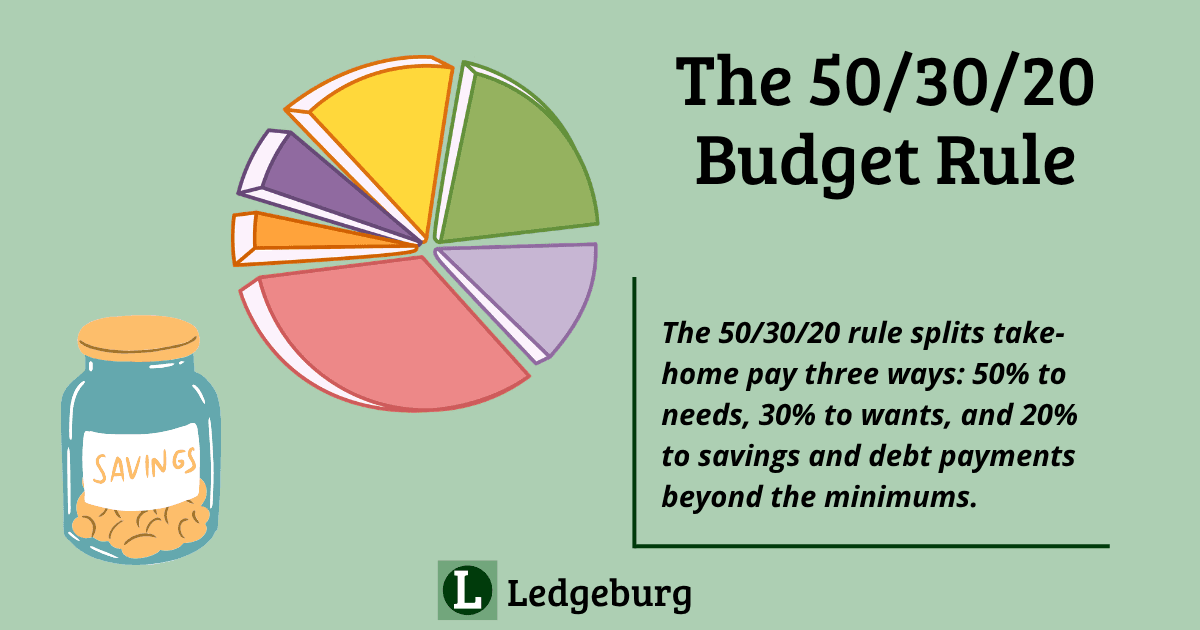
- The 50/30/20 rule allocates take-home pay in three parts: 50% to needs, 30% to wants, and 20% to savings and debt payments beyond the minimums.
- Its strength is simplicity — three categories instead of thirty — which makes it far more likely to survive past the first month than a detailed budget.
- Minimum debt payments count as needs; anything paid above the minimum counts in the 20%, because it is building net worth rather than keeping you current.
- The ratios assume housing costs that are affordable relative to income, which is exactly where the rule fails in expensive cities and on low incomes.
Most budgets die of complexity. Thirty-two spending categories, a spreadsheet with conditional formatting, an app that pings every time a coffee is bought — and by week three, nobody is opening any of it. The 50/30/20 rule exists because of that failure pattern. It reduces an entire household budget to three numbers, on the theory that a crude plan you actually follow beats a precise one you abandon.
The rule was popularised by Elizabeth Warren and Amelia Warren Tyagi in All Your Worth (2005), and it has survived two decades of financial fashion largely because it is easy to remember and difficult to misapply. This guide covers what belongs in each bucket, a worked example, and the specific circumstances in which the ratios stop making sense.
What the Rule Says
Take-home pay is divided three ways:
The base figure is take-home pay — what lands in your account after tax and payroll deductions — not gross salary. If your employer deducts a pension contribution before paying you, that money is already saved and should not be counted again inside the 20%.
Note what the rule deliberately does not do. It sets no grocery budget, no limit on restaurants, no target for fuel. Within the wants bucket, you can spend however you like. That permissiveness is a feature: the framework only asks you to hold three totals, which is a small enough demand to sustain.
What Counts as a Need
Needs are the expenses that carry real consequences if unpaid — the ones you would still be facing if your income dropped sharply next month:
- Housing: rent or mortgage payment
- Utilities: electricity, heating, water, basic phone and internet
- Groceries — the food you cook, not the food you order
- Transport required to get to work
- Insurance premiums: health, home or renters, car
- Minimum payments on all debts
- Childcare that enables you to work
The boundary questions are where the rule gets interesting. A car is a need if you cannot reach your job without one; a car two segments above what that job requires is partly a want. Broadband is a need if you work from home. A phone contract is a need; the newest handset on a 36-month plan is not entirely.
What Counts as a Want
Wants are everything that improves life without being required to sustain it: restaurants and takeaways, streaming subscriptions, holidays, hobbies, clothing beyond the practical, gym memberships, the upgraded phone, the second car.
Thirty percent strikes many people as generous, and that is intentional. Budgets that eliminate enjoyable spending get abandoned for the same reason severe diets do. The bucket exists so that discretionary spending is bounded rather than banned.
What Counts in the 20%
The final bucket covers everything that increases net worth:
- Emergency fund contributions
- Retirement saving beyond what is deducted at source
- Investments in a taxable account
- Saving for a house deposit
- Debt payments above the minimum
That last item is the one people most often get wrong. The minimum payment on a credit card belongs in needs, because missing it has immediate consequences. Everything paid on top of the minimum belongs here, because it reduces principal — the balance sheet effect is the same as putting money into savings.
A Worked Example
Someone taking home $5,000 a month:
| Bucket | Target | Actual | Contents |
|---|---|---|---|
| Needs | $2,500 | $2,650 | Rent $1,500, utilities $220, groceries $450, transport $250, insurance $150, debt minimums $80 |
| Wants | $1,500 | $1,150 | Eating out $400, subscriptions $60, hobbies $200, clothing $150, travel fund $340 |
| Savings and debt | $1,000 | $1,200 | Emergency fund $500, investing $500, extra debt payment $200 |
| Total | $5,000 | $5,000 |
Needs are running $150 over target and wants are $350 under, which is exactly how the rule is meant to behave — the buckets absorb each other's variance, and the 20% remains intact. Overspending on needs is only a problem when it eats the savings bucket rather than the wants bucket.
Where the Rule Breaks Down
The 50% needs figure carries a hidden assumption: that housing costs are affordable relative to income. In expensive cities that assumption often fails outright. Rent alone can consume 40 to 50% of take-home pay, leaving no room for the remaining needs, let alone the other two buckets.
The framework is still useful in that situation, just as a diagnostic rather than a target. If your needs come to 65% of income, the rule has told you something specific and actionable: the wants and savings buckets have to be compressed, and the only expense large enough to change the picture materially is housing.
Two other cases where the ratios mislead:
- Lower incomes. When needs are close to fixed in absolute terms, they consume a larger percentage of a smaller income. This is a structural feature of the income, not a budgeting failure, and no reallocation of percentages changes it.
- Higher incomes. Someone taking home $15,000 a month does not need $4,500 of wants. At higher incomes the marginal dollar should be tilting toward the savings bucket, and holding to 30% wants can quietly institutionalise lifestyle inflation.
Adapting the Ratios
Once the framework is running, adjusting it is straightforward. Aggressive savers often run 50/20/30, flipping the wants and savings buckets. Someone attacking high-interest debt might run 55/10/35 temporarily, treating it as a sprint rather than a permanent state. People in expensive cities frequently settle at something like 65/15/20, holding the savings bucket fixed and compressing wants to protect it.
The pattern worth keeping in all of these variants: decide the savings bucket first and let the other two compete for what is left. Saving whatever remains at the end of the month reliably produces a savings rate near zero, because there is always something to spend the remainder on.
When to Use Something Else
The 50/30/20 rule suits people who want a functioning budget with minimal maintenance, who have reasonably stable income, and who do not need to account for money at a granular level. That covers a lot of households.
It is a poor fit when cash flow is genuinely tight, when income varies sharply month to month, or when you are working toward a specific dated goal that demands precision. In those cases zero-based budgeting gives you the control the three-bucket approach deliberately gives up. And if you have not yet measured what you actually spend, start with building the budget itself — no allocation framework helps until the underlying numbers are real.